Residential properties throughout Tarrytown, Hyde Park, and East Cesar Chavez frequently integrate native succulents, decomposed granite, and drought-hardy shrubs that react poorly to standard petroleum-solvent…
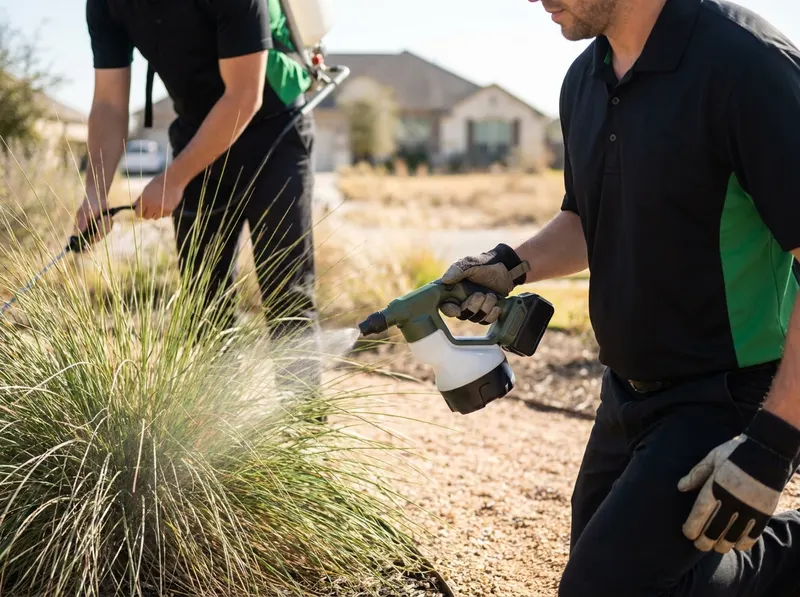
Residential properties throughout Tarrytown, Hyde Park, and East Cesar Chavez frequently integrate native succulents, decomposed granite, and drought-hardy shrubs that react poorly to standard petroleum-solvent chemical sprays. Traditional synthetic sprays can scorch wax layers on blue agave, silver ponyfoot, and soft-leaf yucca during intense triple-digit heat. RiverMint Pest Solutions utilizes water-based botanical formulations that combine cedarwood oil, geraniol, and microencapsulated pyrethrins approved under the EPA 25(b) exempt framework. This targeted integrated pest management approach stops breeding cycles while maintaining plant respiration across arid landscapes.
Mosquito biology in Travis County centers around two distinct vectors: the daytime-biting Aedes albopictus and the dusk-active Culex quinquefasciatus. According to the Centers for Disease Control and Prevention, these species exploit minimal reservoirs of moisture to complete metamorphosis. In neighborhoods like Mueller and Circle C Ranch, drainage collection swales, French drain grates, and subterranean irrigation valves create microclimates that shelter larvae. RiverMint Pest Solutions treats standing subterranean moisture with Bacillus thuringiensis israelensis (BTI), a soil bacterium regulated by the USDA Animal and Plant Health Inspection Service that targets mosquito and blackfly digestive systems without impacting beneficial terrestrial beetles, honeybees, or companion animals.
Effective property suppression demands meticulous barrier zoning. Foliar applications target the undersides of broadleaf perimeters, structural overhangs, and shaded limestone crevices rather than open turfgrass. The trade-off between broad-spectrum synthetic neurotoxins and botanical barrier misting comes down to residual persistence versus ecological safety: petroleum-heavy synthetics remain active for 30 to 45 days but present toxicity warnings monitored by the Texas Department of Agriculture, whereas botanical formulations provide 21 to 28 days of perimeter reduction without leaving oily slicks on flagstone patios or damaging native pollinator pathways documented by the Lady Bird Johnson Wildflower Center.
Properties near waterways such as Lady Bird Lake, Barton Springs Pool, and McKinney Falls State Park face strict municipal runoff guidelines under the City of Austin Watershed Protection Department. Runoff containing standard organophosphates creates aquatic hazards outlined by the Texas Parks and Wildlife Department and the U.S. Fish and Wildlife Service. Applying naturally derived barrier repellents alongside surface-tension modifiers endorsed by the American Mosquito Control Association prevents unintended chemical drift into riparian corridors. Property managers in Avery Ranch and Zilker can maintain zero-standing-water protocols by inspecting corrugated downspout extensions and automated drip manifold boxes every 14 days, as reinforced through local environmental safety programs at the Travis County Natural Resources division.
Every job gets a firm, written price after a free on-site visit.
For standards, safe disposal, and service guidance on pest control services in Austin, TX, useful references include U.S. EPA, ENERGY STAR, U.S. Dept. of Energy, Consumer.gov, U.S. Census Bureau, and Google Maps. General consumer and small-business resources are available from USA.gov, Better Business Bureau, FTC Consumer Advice, U.S. Small Business Administration, and Ready.gov.
Tell us about your xeriscape-safe mosquito abatement job in Austin and we'll send a clear, written quote, usually the same day.
 RiverMint Pest Solutions